
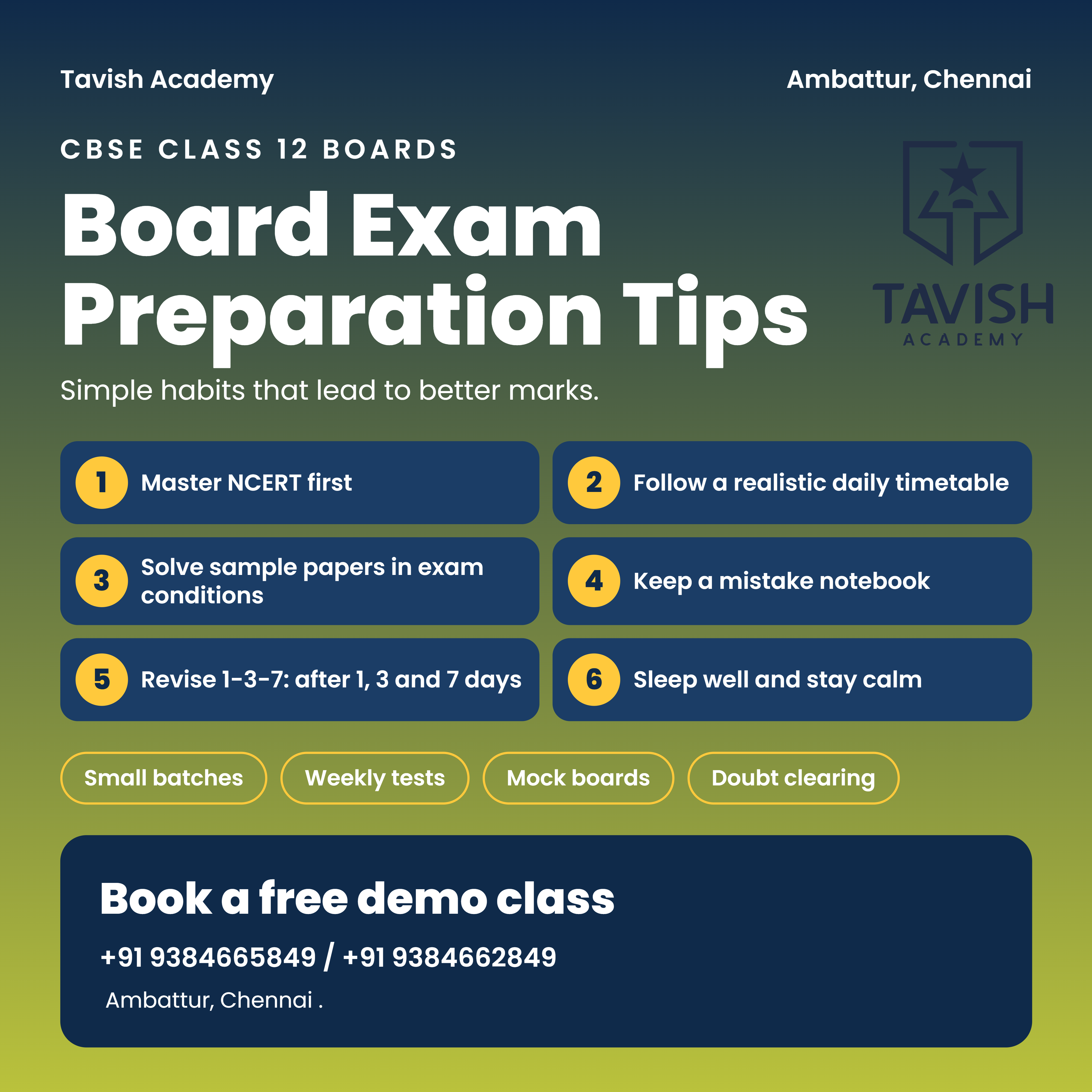
CBSE Class 12 Board Exam Preparation Tips from Tavish Acadamy, Ambattur
The Class 12 board exam is one of the milestones in a students school life. Your marks decide college admissions, eligibility for entrance exams and often the course you choose for your career. The good news is that boards reward thoughtful preparation much more, than last‑minute effort.
At Tavish Acadamy, we have guided many CBSE students in Ambattur through their Class 12 year. In this post, our faculty shares the strategies that work best.
Start with the Syllabus and Exam Pattern
Before opening a single book, download the latest CBSE syllabus and marking scheme from the official CBSE website. Note down:
- The chapters and units in each subject, with their weightage
- The split between theory, practical and internal assessment marks
- The types of questions asked: MCQs, case-based questions, short and long answers
CBSE has been placing more weight on competency-based and application questions, so understanding concepts matters more than memorising answers.
Build a Realistic Study Timetable
A good timetable is one you can actually follow. Keep these points in mind:
-
Study 5 to 7 focused hours a day on school days, and a little more on weekends.
-
Give difficult subjects your freshest hours, usually early morning.
-
Rotate subjects so you don't get bored or tired of one.
-
Add a weekly revision slot and one short break day to avoid burnout.
-
Take 10-minute breaks after every 50 minutes of study.
Students in Ambattur often lose time travelling between school and tuition, so plan your hours around your commute instead of ignoring it.
Subject-Wise Tips
Mathematics
Practise daily. Maths cannot be learned by reading alone. Keep a formula sheet, solve previous years' questions, and focus on presenting steps clearly, since step marking is common.
Physics
Understand derivations rather than memorising them. Practise numericals every day and revise units, laws and ray diagrams regularly.
Chemistry
Divide your time between Physical, Organic and Inorganic. Keep named reactions and reagents in a separate notebook. For Inorganic, revise the NCERT text repeatedly.
Biology
Labelled diagrams carry marks, so practise them. Use flowcharts and tables for processes like photosynthesis, reproduction and genetics.
Accountancy, Business Studies and Economics
Practise journal entries and financial statements regularly. For theory, write answers in points with key terms highlighted. In Economics, learn to draw graphs neatly.
English
Practise the writing section (letters, notices, reports and articles) in the correct format. For literature, understand themes and characters instead of memorising summaries.
Computer Science / Informatics Practices
Practise programs on a computer or on paper, and revise SQL queries, output questions and file handling.
Solve Sample Papers and Previous Year Papers
This is the single most effective way to prepare.
- Start solving sample papers at least 2 to 3 months before the exam.
- Attempt each paper in exam conditions: 3 hours, no books, no phone.
- Check your answers against the official marking scheme.
- Keep a mistake notebook and revise it before every new test.
At Tavish Acadamy, we conduct regular tests based on the board pattern so students become comfortable with the paper format and time pressure well before the actual exam.
Revise Smartly
-
Make short notes and mind maps for each chapter.
Follow the 1-3-7 rule: revise a topic after 1 day, 3 days and 7 days.
Teach a friend or explain concepts aloud. If you can explain it, you know it.
Revise high-weightage chapters twice before the exam.
How Tavish Acadamy Supports Class 12 Students in Ambattur
At Tavish Acadamy, our CBSE Class 12 programme includes:
- Experienced subject teachers for each stream
- Small batches for personal attention
- Concept-based teaching aligned with NCERT and the latest CBSE pattern
- Weekly tests, mock boards and detailed answer analysis
Whether your child is aiming for 90% or simply wants to strengthen weak areas, we help build a plan that fits.
Scoring well in CBSE Class 12 is not about studying all day. It is about knowing the syllabus, practising consistently and staying calm. Start early, stay regular and ask for help when you need it.
